How can we help you?

Recent Searches Clear All
    Methods for Pipeline Inspection

    Dec.05,2025

    Pipeline inspection can be divided into two parts, namely, pipeline inner inspection and pipeline outer inspection. Today let us focus on what the pipeline inspection is. Inner pipe inspection is very useful for future rectification of drainage pipes. Drainage pipelines are an important part of urban infrastructure. To ensure that the urban pipeline network remains unblocked, the maintenance of the drainage pipeline network is very important. Rain and sewage drainage pipes in each city are generally constructed by the city's local municipal water company or contracted to a professional pipe maintenance company for maintenance. And underground pipe inspection is an important part of urban pipeline maintenance.


    1. Common pipeline inspection methods

    Common pipeline inspection methods and pipeline inspection equipment include pipeline camera inspection, pipeline QV inspection, and pipeline sonar inspection. These three pipeline inner inspection methods can basically meet the needs of municipal official network inspection, and the needs of street, community, and enterprise inspection.


    2. How does the pipe inspection camera work?

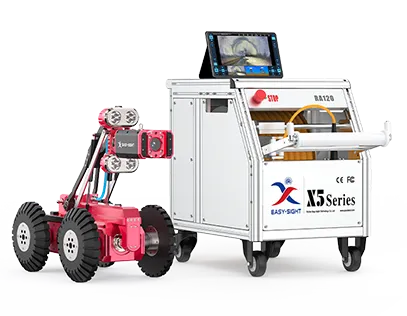
    The pipe inspection camera can monitor and record the conditions inside the pipeline in real time, including the degree of deformation, blockage, siltation, corrosion, etc. And it can get accurate locations, shoot high-definition videos and take pictures. If we turn on the high-definition camera of the robot, we can clearly see the internal situation of the rain and sewage drainage pipe as the robot slowly climbs into the pipe. We can see whether there are functional defects such as blockage, deposition, scaling, and scum, or structural defects such as the hidden connection of branch pipes, mixed rain and sewage, pipeline rupture, undulation, deformation, and water seepage.


    Then these captured videos and pictures are transmitted to the ground via the network. Finally, the construction technicians on the ground can judge various functional and structural defects inside the pipeline through the transmitted video images and intercepted pictures, and then make a pipeline inspection and evaluation report, which is of great significance to the later pipeline repair and transformation work. Since pipeline repair and transformation are determined by the inspection of the damage and its location.


    Latest News

    • Dec.05,2025

      Overcoming Challenges Faced by Pipe Crawler Robots in Navigating Complex Pipe Networks

      In recent years, the use of pipe crawler robots has become increasingly prevalent in various industries such as oil and gas, water management, and construction. These innovative robots are designed to navigate through intricate pipe networks with ease, carrying out inspections, maintenance, and repairs efficiently. However, despite their advanced capabilities, pipe crawler robots face several challenges when operating in complex pipe networks. In this blog post, we will explore some of the common obstacles faced by these robots and how engineers are working to overcome them.

    • Dec.05,2025

      Inserted Lining High-Density Polyethylene (HDPE) Pipeline Repair Technology

      Inserted lining high-density polyethylene (HDPE) pipe is a brand new pipe rehabilitation technology. The technology is to insert a HDPE pipe of suitable size into the old pipe that needs to be repaired. It takes advantage of the rigidity and strength of the old pipeline as the bearing structure, as well as the characteristics of HDPE pipe's corrosion resistance, wear resistance and permeability resistance, to form a "pipe in pipe" composite structure, so that the repaired pipeline has the comprehensive performance of steel pipe and HDPE pipe. This technology, by using the feature of HDPE pipe that it can automatically recover its original physical shape after deformation, is to retract HDPE pipe with special equipment. Before inserting, the lining pipe is pulled into the target pipe with a certain traction force as well as speed. Then the pulling force is removed and the liner is restored to its original diameter and tightly bonded with the outer pipe. The outer diameter of the lineing pipe is slightly larger than the inner diameter of the original tube. After the lining is completed, the lining pipe and the original tube are firmly combined and the thickness of the liner can be designed according to the needs.

    • Dec.05,2025

      Trenchless Rehabilitation Technology and Application of Pipeline Lining

      Since the rise of pipeline trenchless rehabilitation technology in developed countries in the 1980s, it has become a widely used method for underground pipeline rehabilitation. By avoiding large-scale excavation, this technology reduces the impact on urban traffic, the environment, and residents' lives, hence gaining extensive attention and preference. This article will provide a detailed introduction to the main methods and application fields of trenchless rehabilitation technology and analyze its important role in urban network renovation.

    Get Friendly Advice, Tailored to You!

    Let's Talk About Your Project

    • Afghanistan
    • Albania
    • Algeria
    • American Samoa
    • Andorra
    • Angola
    • Anguilla
    • Antarctica
    • Antigua and Barbuda
    • Argentina
    • Armenia
    • Aruba
    • Australia
    • Austria
    • Azerbaijan
    • Bahamas
    • Bahrain
    • Bangladesh
    • Barbados
    • Belarus
    • Belgium
    • Belize
    • Benin
    • Bermuda
    • BBhutan
    • Bolivia
    • Bosnia and Herzegovina
    • Botswana
    • Bouvet Island
    • Brazil
    • British Indian Ocean Territory
    • Brunei Darussalam
    • Bulgaria
    • Burkina Faso
    • Burundi
    • Cambodia
    • Cameroon
    • Canada
    • Cape Verde
    • Cayman Islands
    • Central African Republic
    • Chad
    • Chile
    • China
    • Christmas Island
    • Cocos (Keeling) Islands
    • Colombia
    • Comoros
    • Congo
    • Cook Islands
    • Costa Rica
    • Cote D'Ivoire
    • Croatia
    • Cuba
    • Cyprus
    • Czech Republic
    • Denmark
    • Djibouti
    • Dominica
    • East Timor
    • Ecuador
    • Egypt
    • El Salvador
    • Equatorial Guinea
    • Eritrea
    • Estonia
    • Ethiopia
    • Falkland Islands (Malvinas)
    • Faroe Islands
    • Fiji
    • Finland
    • France, Metropolitan
    • French Guiana
    • French Polynesia
    • Gabon
    • Gambia
    • Georgia
    • Germany
    • Ghana
    • Gibraltar
    • Greece
    • Greenland
    • Grenada
    • Guadeloupe
    • Guam
    • Guatemala
    • Guinea
    • Guinea-Bissau
    • Guyana
    • Haiti
    • Honduras
    • Hong Kong, China
    • Hungary
    • Iceland
    • India
    • Indonesia
    • Iran (Islamic Republic of)
    • Iraq
    • Ireland
    • Israel
    • Italy
    • Jamaica
    • Japan
    • Jordan
    • Kazakhstan
    • Kenya
    • Kiribati
    • North Korea
    • South Korea
    • Kuwait
    • Kyrgyzstan
    • Lao People's Democratic Republic
    • Latvia
    • Lebanon
    • Lesotho
    • Liberia
    • Libyan Arab Jamahiriya
    • Liechtenstein
    • Lithuania
    • Luxembourg
    • Macau
    • Madagascar
    • Malawi
    • Malaysia
    • Maldives
    • Mali
    • Malta
    • Marshall Islands
    • Martinique
    • Mauritania
    • Mauritius
    • Mayotte
    • Mexico
    • Micronesia
    • Moldova
    • Monaco
    • Mongolia
    • Montserrat
    • Morocco
    • Mozambique
    • Myanmar
    • Namibia
    • Nauru
    • Nepal
    • Netherlands
    • New Caledonia
    • New Zealand
    • Nicaragua
    • Niger
    • Nigeria
    • Niue
    • Norfolk Island
    • Northern Mariana Islands
    • Norway
    • Oman
    • Pakistan
    • Palau
    • Panama
    • Papua New Guinea
    • Paraguay
    • Peru
    • Philippines
    • Pitcairn
    • Poland
    • Portugal
    • Puerto Rico
    • Qatar
    • Reunion
    • Romania
    • Russian Federation
    • Rwanda
    • Saint Kitts and Nevis
    • Saint Lucia
    • Saint Vincent and the Grenadines
    • Samoa
    • San Marino
    • Saudi Arabia
    • Senegal
    • Seychelles
    • Sierra Leone
    • Singapore
    • Slovak Republic
    • Slovenia
    • Solomon Islands
    • Somalia
    • South Africa
    • Spain
    • Sri Lanka
    • St. Helena
    • Sudan
    • Suriname
    • Swaziland
    • Sweden
    • Switzerland
    • Syrian Arab Republic
    • Taiwan, China
    • Tajikistan
    • Tanzania
    • Thailand
    • Togo
    • Tokelau
    • Tonga
    • Trinidad and Tobago
    • Tunisia
    • Turkey
    • Turkmenistan
    • Turks and Caicos Islands
    • Tuvalu
    • Uganda
    • Ukraine
    • United Arab Emirates
    • United Kingdom
    • United States
    • Uruguay
    • Uzbekistan
    • Vanuatu
    • Vatican City State (Holy See)
    • Venezuela
    • Viet Nam
    • Virgin Islands (U.S.)
    • Wallis and Futuna Islands
    • Western Sahara
    • Yemen
    • Zambia
    • Zimbabwe
    • Montenegro
    • Serbia
    • Palestine
    • South Sudan
    • Jersey
    sales@easysight.cn
    +86 188 7185 8099