How can we help you?
Recent Searches Clear All
News
For the inspection, repair, operation, and digital management of urban water supply and drainage networks
Dec.05,2025
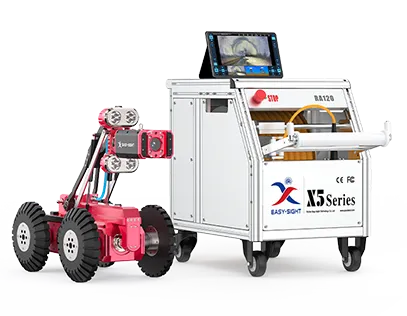
CCTV Pipeline Inspection is a pipeline inspection robot system that can be used for internal camera inspection and measurement work of drainage pipes. It has strong power performance, excellent driving and obstacle-clearing capabilities, and can operate normally even under harsh pipeline conditions.
CCTV Pipeline Inspection mainly involves using closed-circuit television recordings to enter the drainage pipes with camera equipment, transmitting image data to the control computer for data analysis. It can carry out image processing, record the rotation and positioning of the camera, and has high-quality image recording and text editing functions. Its main working components are a four-wheel-drive camera vehicle and a computer.
Compared with traditional pipeline inspection methods, it has the following obvious advantages:
No personnel need to enter the pipeline directly, completely avoiding potential personal accidents;
By utilizing modern technology, work efficiency and quality have been greatly improved, allowing faster and more accurate detection of issues inside the pipeline, identifying the root causes of problems, significantly reducing troubleshooting time;
Provides reliable and accurate basis for determining pipeline repair, clearance, and cleaning schemes;
Offers a scientific and effective method for pipeline construction completion acceptance and inspection of pipeline conditions.
Components of CCTV Pipeline Inspection Equipment
CCTV Pipeline Inspection equipment mainly consists of a camera crawling system, control cable, and control console.
Camera crawling system: The crawling system propels the camera equipment into the pipeline, capturing images of the pipeline interior with the camera system and transmitting the images to the control console in real-time;
Control cable: Responsible for transmitting instructions to the crawling device and real-time image data;
Control console: CCTV core operating system, responsible for issuing control instructions such as advancing and retracting the crawling system, camera system lighting, etc.; receiving image data and storing image data in storage devices.
Uses of CCTV Pipeline Inspection Equipment
By operating the main controller's human-machine interface, control the crawler to move inside the pipeline, transmitting the collected pipeline internal images in real-time to the main controller for real-time monitoring. Detect and image rust layers, scale, corrosion, perforations, cracks, etc., inside the pipeline and evaluate them based on the inspection technical regulations, providing important basis for creating repair plans.
According to the "Technical Regulations for Urban Drainage Pipeline Inspection and Assessment" CJJ181—2012, "Technical Regulations for the Maintenance of Urban Drainage Channels and Pump Stations" CJJ68—2007, "Technical Regulations for Urban Drainage Pipeline Maintenance Safety" CJJ6—2009, and "Construction and Acceptance Specifications for Water Supply and Drainage Pipeline Engineering" GB50268—2008, evaluate the structural and functional condition of the inspected pipeline and provide recommendations for repair and maintenance based on the actual inspection results.
CCTV Pipeline Inspection technology has not been in use for long but has developed very rapidly. In some developed countries and regions internationally, it has been widely applied for systematic inspection of drainage pipes, preventing pollution caused by leakage, and monitoring and preventing geological disasters (such as landslides). In recent years, some major cities in China have started using this inspection system and achieved very good results.
Latest News
Sep.18,2026
Common Problems Detected by Modern Pipe Inspection Equipment
Sep.17,2026
Pipe Inspection Equipment Cost Factors: What Affects the Investment?
Sep.16,2026
Pipe Inspection Equipment Selection Guide for Different Pipeline Diameters
Get Friendly Advice, Tailored to You!
Let's Talk About Your Project