How can we help you?
Recent Searches Clear All
News
For the inspection, repair, operation, and digital management of urban water supply and drainage networks
Dec.05,2025
Working principle of pipeline inspection robot
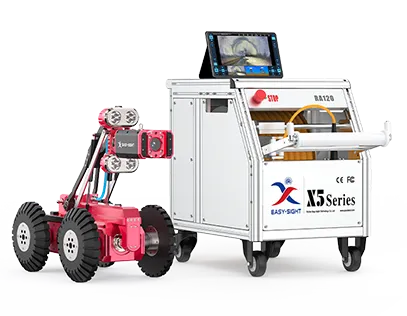
The pipeline inspection robot is a monitoring device that can quickly and accurately detect the entire pipeline simultaneously. Its main function is to attach a remote control handle that can automatically adjust the length of the pipeline and put a monitoring camera directly into an inspection well or other In a fixed space, operating technicians can conduct real-time observation through the automatic adjustment of the controller.
Since the pipeline's internal structure photometric content detector is equipped with a very powerful long ultraviolet light source, the sunlight fullness in the entire pipeline is relatively small, and it can measure the entire pipeline within a diameter of 200-1500mm. The nozzle structure of each pipeline link is inspected in real-time, and the utilization of the overall internal structure of the entire pipeline is observed.
Under special conditions where the internal structure of the entire pipeline is ideal, the pipeline depth of the pipeline inspection robot is relatively large, and the detection depth can generally reach 80 meters, which can clearly and accurately display the internal structure, cracks, blockages, etc. of the entire pipeline. The utilization status of the internal structure of the pipeline can accurately analyze and judge the utilization performance of the overall internal structure of the entire pipeline and the existence of internal defects, and provide important scientific and technological content testing and test basis for enterprises to strengthen the daily construction maintenance and repair quality management of the entire pipeline.
Packaging requirements for pipeline inspection robots
The product packaging of the pipe inspection robot is in accordance with the relevant requirements. All the products used in the package must pass the inspection and audit of the relevant product inspection agency, and the product documents used in the vehicle are complete. The selection of materials in the product packaging process should try to ensure that the product has sufficient weight and high strength to ensure that the product packaging process of the entire enterprise can be safe and reliable, and it can withstand multiple large-gravity mobile loading and unloading, transportation and packaging processes without any mechanical damage, deformation, and product reduction. The transportation process is accurate, rusted, and lost, and can be safely and reliably packaged and delivered to the site to the designated destination.
The pipe inspection system has many conveniences, and its basic investment is relatively small. Compared with others, this system has many powerful advantages. Under the general use conditions of material inspection equipment, it can easily meet the regular inspection of various large-scale structural material defects of transportation pipelines.
Latest News
Aug.04,2026
A Leading Global Manufacturer of Trenchless Rehabilitation Materials
As a full-lifecycle service provider for smart pipeline network operations and maintenance, Easy-Sight delivers a one-stop solution covering inspection, maintenance, repair, management, and service for urban water supply and drainage networks.
Jul.20,2026
Recently, the T300 tracked all-terrain drainage inspection robot, nicknamed the “Versatile Explorer,” jointly developed by the Hong Kong Drainage Services Department and EASY-SIGHT was presented as one of the department’s key innovation achievements at several major international exhibitions and official events.
Jul.14,2026
On the morning of July 8, the 2025 National Science and Technology Awards Conference was held at the Great Hall of the People in Beijing.
Get Friendly Advice, Tailored to You!
Let's Talk About Your Project