How can we help you?
Recent Searches Clear All
News
For the inspection, repair, operation, and digital management of urban water supply and drainage networks
Dec.05,2025
Inserted lining high-density polyethylene (HDPE) pipe is a brand new pipe rehabilitation technology. The technology is to insert a HDPE pipe of suitable size into the old pipe that needs to be repaired. It takes advantage of the rigidity and strength of the old pipeline as the bearing structure, as well as the characteristics of HDPE pipe's corrosion resistance, wear resistance and permeability resistance, to form a "pipe in pipe" composite structure, so that the repaired pipeline has the comprehensive performance of steel pipe and HDPE pipe. This technology, by using the feature of HDPE pipe that it can automatically recover its original physical shape after deformation, is to retract HDPE pipe with special equipment. Before inserting, the lining pipe is pulled into the target pipe with a certain traction force as well as speed. Then the pulling force is removed and the liner is restored to its original diameter and tightly bonded with the outer pipe. The outer diameter of the lineing pipe is slightly larger than the inner diameter of the original tube. After the lining is completed, the lining pipe and the original tube are firmly combined and the thickness of the liner can be designed according to the needs.
Main Technical Performance:
The Thickness of the Lining pipe is 4 to 20mm;
Operating Temperature: -40℃ to 60℃;
Working Pressure: 1.2 times the working pressure of the original pipe.
Technical features: (Compared with other old pipeline repair methods, the inserted method for repairing old pipelines has the following characteristics)
High pressure bearing capacity;
Low requirements for cleaning old pipelines, reducing pigging time and investment;
The repair distance is long at a time, the number and workload of the excavation point are small during work;
The flange is formed out of the lining pipe, which has good integrity and tightness;
The construction period is short, thereby reducing the downtime.
You may also be interested in the following products:
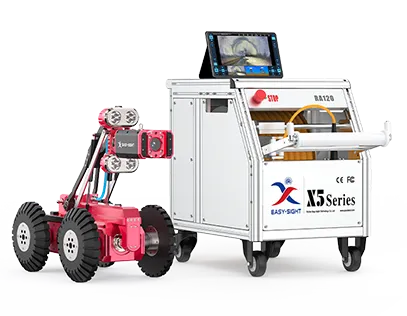
Robotic crawler pipe inspection system
Pipe cleaning robot
Underground pipe inspection
CCTV crawler
Robotic pipe inspection camera
Sewer inspection robot
Latest News
Sep.04,2026
Technology for Safer Infrastructure | Easy-Sight Showcases Innovations at the 2026 High-Tech Launch Event in Hong Kong
Aug.25,2026
Why Municipal Pipeline Networks Need Pipeline Inspection Robots: Analysis of Four Major Technical Advantages
Aug.14,2026
Key Advantages and Suitable Applications of UV-CIPP Ultraviolet-Curable Repair Material
Get Friendly Advice, Tailored to You!
Let's Talk About Your Project