How can we help you?
Recent Searches Clear All
News
For the inspection, repair, operation, and digital management of urban water supply and drainage networks
Sep.28,2026
How Pipe Inspection Equipment Improves Underground Pipeline Maintenance Efficiency starts with one practical change: inspecting buried assets before excavation or emergency repair begins. I use inspection cameras, robotic crawlers, sonar, laser scanners, and other non-destructive pipeline testing equipment to identify defects without exposing the entire line. These systems provide non-invasive assessment, faster defect localization, safer targeted repairs, and data-driven maintenance planning. The result is a maintenance process that replaces assumptions with condition data and helps operators decide where intervention is necessary.
Underground pipeline inspection equipment is a group of cameras, sensors, robotic platforms, locating devices, and software used to examine buried pipes from access points or from inside the pipeline. The equipment can record images, measure dimensions, detect leaks, identify sediment, and document structural changes without requiring continuous excavation. Typical systems include CCTV pipe inspection cameras, pipeline crawlers, manhole cameras, sonar platforms, laser scanners, ultrasonic tools, magnetic testing equipment, and in-line inspection tools.
I treat the equipment as part of a complete inspection workflow rather than as a single device. A camera may reveal a crack, but a laser scanner can quantify deformation, while sonar can inspect a water-filled pipe where optical cameras cannot see the wall clearly. The correct combination depends on pipe diameter, material, fluid condition, access points, operating pressure, defect type, and the maintenance decision that must follow.
!
Pipe inspection equipment improves maintenance efficiency by reducing unnecessary excavation, locating defects before they become emergencies, shortening inspection time, and producing records that support targeted repair decisions. Remote cameras and robotic systems allow operators to inspect from manholes, access points, or pipeline interiors instead of opening long sections of ground. Inspection data can then be linked to location, severity, pipe condition, and repair priority, helping maintenance teams allocate labor and budgets more accurately.
The efficiency gain is not only about completing an inspection faster. It also comes from avoiding the wrong repair, reducing repeat site visits, limiting traffic disruption, improving worker safety, and creating a consistent condition history for each asset. Easy-Sight presents its product range as covering inspection, rehabilitation, operation, and digital management for urban water supply and drainage networks, which reflects the wider value of connecting inspection results to later maintenance actions.
CCTV cameras and robotic crawlers can identify visible defects such as cracks, open joints, root intrusion, corrosion, deposits, blockages, broken sections, and deformation. A crawler moves through the pipe while transmitting video to an operator above ground, allowing the team to review the internal condition without entering a confined space. Pan-and-tilt cameras can examine service connections, joints, manholes, and areas that would be difficult to view with a fixed camera.
For leaks, optical inspection may show the symptom but not always the source or flow rate. In those cases, operators may combine CCTV with acoustic sensing, pressure testing, ultrasonic inspection, or dedicated leak-detection equipment. This distinction matters because a dark mark, water movement, or discoloration is not automatically proof of a structural leak. The inspection method must match the defect hypothesis.
Inspection equipment reduces excavation and repair costs by identifying the approximate location, size, and severity of a defect before digging begins. Instead of exposing an entire pipe section, a contractor can excavate at a targeted point or select a trenchless repair method where the condition allows it. This can reduce pavement removal, soil handling, traffic control, restoration work, and the risk of damaging adjacent utilities.
I would measure this benefit through operational metrics rather than general claims. Useful indicators include excavation length per repair, number of exploratory excavations avoided, average time from inspection to repair location, percentage of repairs supported by recorded evidence, and repeat-visit frequency. A utility can compare these figures before and after adopting inspection equipment to calculate actual maintenance savings.
Different technologies answer different inspection questions. The table below shows where each method is most useful and where its limitations should be considered.
| Technology | Best inspection use | Main data produced | Important limitation |
|---|---|---|---|
| CCTV camera | Cracks, blockages, corrosion, joints, roots, deposits | Video, images, defect observations | Visibility decreases with water, sediment, or poor lighting |
| Robotic crawler | Medium and large pipelines requiring controlled movement | Video, distance, location, operating records | Needs suitable access, traction, and internal clearance |
| Sonar system | Water-filled or submerged pipes and culverts | Sediment profile, underwater shape, structural indications | Interpretation may be less direct than optical imaging |
| Ultrasonic testing | Wall thickness, corrosion, selected material conditions | Thickness or acoustic measurements | Requires surface and material conditions suitable for sensing |
| Magnetic testing | Certain metal-pipe defects and corrosion patterns | Magnetic response and discontinuity indications | Less suitable for non-metallic pipes |
| Laser scanning | Deformation, diameter, cross-section, volume, geometry | Point clouds, profiles, 3D measurements | Requires clean enough surfaces and controlled data processing |
| In-line inspection tools | Long pressurized pipelines with suitable internal access | Geometry, metal loss, cracks, and other sensor data | Tool compatibility depends on diameter, bends, valves, and flow |
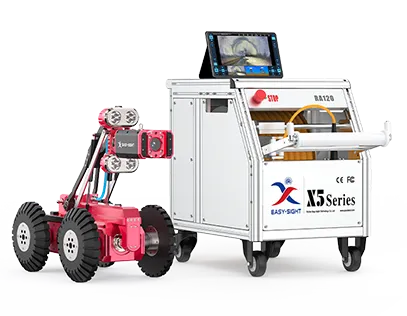
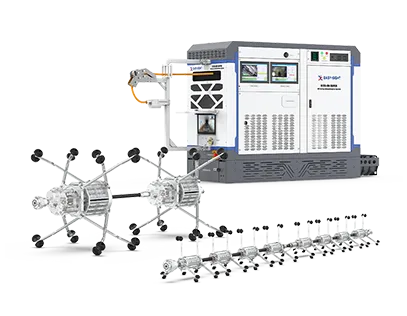
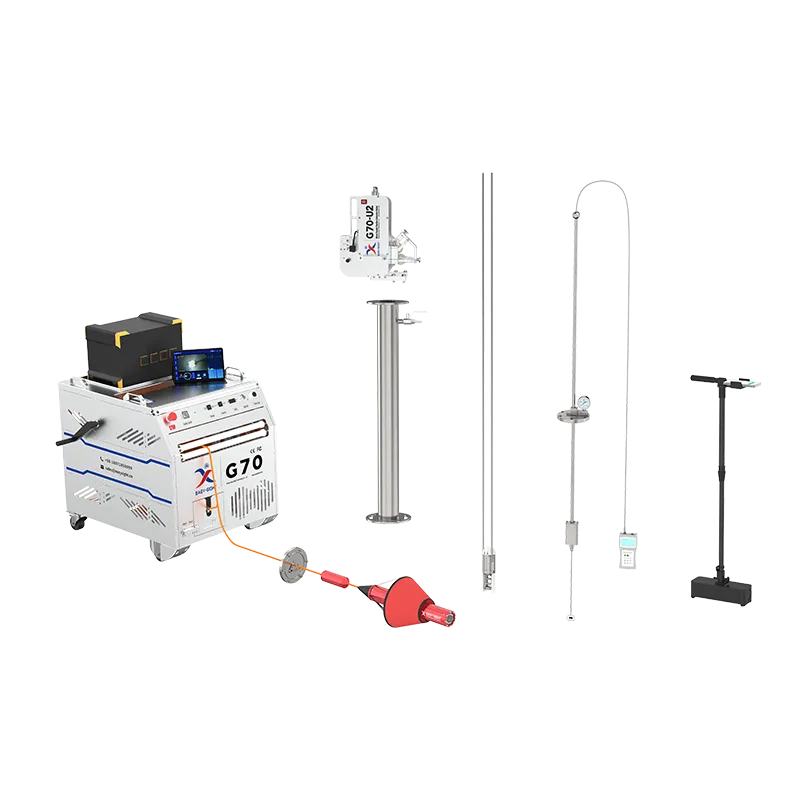
Easy-Sight’s product range illustrates how equipment selection changes with the inspection environment. Its systems include CCTV robots, pole cameras, manhole cameras, sonar systems, small-diameter platforms, long-distance robots, high-precision equipment, and all-terrain inspection robots. The company lists applications ranging from compact DN100–DN250 municipal pipelines to large-diameter systems covering 500–3000 mm pipes and inspection distances up to 1050 m.
CCTV is usually the starting point for underground pipeline condition assessment because it provides direct visual evidence. A push camera is suitable for short runs and smaller pipes, while a crawler is better when the inspection requires controlled travel, distance measurement, adjustable lighting, or longer operating ranges. Robotic crawlers are also useful when confined-space entry would create unacceptable safety exposure.
Easy-Sight’s X5-HM100 is listed for community and municipal storm or sewer pipelines from DN100 to DN250, while its X5-HW1000 is designed for 500–3000 mm pipelines with a stated inspection distance of up to 1050 m. These specifications show why pipe diameter and required travel distance must be confirmed before purchase. A system designed for small municipal lines cannot automatically serve large industrial or drainage assets.
Sonar becomes important when a pipeline cannot be fully dewatered or when water obscures the pipe wall. The system sends acoustic signals through water and uses the returning signal to estimate underwater geometry, sediment buildup, or structural features. It can extend the inspection window when a conventional camera would produce incomplete footage.
However, sonar does not replace CCTV in every situation. It may show a sediment profile or abnormal shape without providing the same visual confirmation as an optical camera. I would use sonar results with operating history, cleaning records, hydraulic data, and, where possible, follow-up visual inspection.
Laser scanning is useful when the maintenance decision depends on geometry rather than appearance. It can quantify diameter loss, ovality, deformation, cross-sectional reduction, and internal profiles. Easy-Sight describes its QS-D pipe diameter gauge as using 360-degree laser scanning, with a stated measurement accuracy of ±2 mm and error within 0.2%; those figures should still be verified under the actual pipe surface, lighting, and deployment conditions.
Ultrasonic testing can support wall-thickness assessment, particularly when corrosion or metal loss is suspected. Magnetic testing can identify discontinuities in suitable ferromagnetic materials, but it is not a universal option for concrete, clay, plastic, or composite pipelines. These technologies require trained operators, correct calibration, and a clear understanding of how the measured signal relates to the defect.
I begin by defining the decision the inspection must support. The objective may be to locate a blockage, verify a suspected leak, assess corrosion, measure deformation, confirm a repair, or rank a group of assets for rehabilitation. Without a defined objective, teams often collect large volumes of video that do not answer the maintenance question.
The planning stage should record pipe material, nominal diameter, length, access points, flow condition, expected sediment, operating temperature, pressure, and previous failure history. It should also identify whether the line is suitable for a camera, crawler, sonar system, in-line tool, or a combination of methods.
Before deployment, the team should verify access, clean excessive debris where necessary, inspect cables and connectors, test lighting, confirm battery capacity, and check calibration records. For a crawler, wheel or track selection must match the pipe surface and expected slope. For an in-line tool, operators must confirm internal diameter, bends, valves, launch and retrieval arrangements, and flow conditions.
During the inspection, the operator should record chainage or distance, clock position, defect type, defect dimensions, service connections, changes in pipe material, and any obstruction that affects data quality. Images and video should be tied to a location reference rather than stored as unstructured files. This makes later comparison more reliable.
After inspection, I classify findings by severity, consequence, confidence, and urgency. A small surface crack in a low-consequence line may require monitoring, while a deformation that restricts flow near a critical facility may require immediate intervention. The decision should consider probability of failure and consequence of failure rather than visual appearance alone.
Pipeline inspection reporting software can support defect coding, image capture, mapping, measurement, and report generation. Easy-Sight states that some of its inspection systems can record high-definition video, capture defect images, and generate reports immediately after inspection. Its quick-view camera system also describes reports containing project information, defect distribution, equipment details, workflow, and defect statistics.
AI-assisted image review can help identify likely defects, sort footage, and flag sections for human verification. It should be treated as a review aid rather than a final authority because poor lighting, sediment, motion blur, and unusual pipe materials can create false positives or missed defects. The most reliable workflow combines automated screening with trained operator confirmation and retained evidence.
GIS integration adds another layer by connecting inspection findings to pipe location, diameter, material, age, service criticality, past repairs, and nearby excavation constraints. Three-dimensional reconstruction and sensor fusion can combine laser profiles, sonar data, camera imagery, and asset coordinates into a more complete condition model. Over several inspection cycles, this information supports predictive maintenance by showing whether a defect is stable, growing, or associated with repeated failures.
Pipe inspection equipment is not a substitute for engineering judgment. Cameras may miss defects behind sediment, submerged sections, or heavily corroded surfaces. Crawlers can lose traction, become obstructed, or fail to pass changes in diameter. Sonar and laser measurements can be affected by water quality, surface texture, alignment, calibration, and data-processing assumptions.
I also consider total cost of ownership instead of purchase price alone. The calculation should include equipment acquisition, transport, training, calibration, software, batteries, cable maintenance, replacement parts, cleaning, insurance, storage, and downtime during servicing. A lower-cost system may become more expensive if it requires repeated inspections, produces incomplete data, or cannot serve the pipe sizes and conditions present in the operator’s network.
A practical comparison should measure:
I match technology to four factors: pipeline material, operating conditions, defect type, and inspection objective. The following framework provides a starting point.
| If the priority is… | Consider… | Why |
|---|---|---|
| Rapid visual screening from an access point | Pole camera or manhole camera | Fast deployment for preliminary checks |
| Detailed inspection of a drain or sewer | CCTV crawler | Controlled travel and recorded visual evidence |
| Inspection through standing water | Sonar system | Captures underwater geometry and sediment information |
| Measuring ovality or deformation | Laser scanner or diameter gauge | Produces quantitative cross-sectional data |
| Suspected metal loss | Ultrasonic or magnetic testing | Adds material or wall-condition information |
| Long pressurized pipeline assessment | In-line pipe inspection tools | Covers long distances internally when compatible |
| Difficult terrain or heavy sediment | All-terrain robotic system | Designed for reduced traction and complex conditions |
| Small municipal pipelines | Compact crawler or push camera | Fits restricted diameters and access conditions |
Easy-Sight is one supplier example with equipment spanning compact quick-view cameras, CCTV crawlers, sonar systems, all-terrain robots, diameter gauges, and panoramic surveying systems. Its published product information includes tablet-based control, wireless connection between system components, high-definition video recording, and equipment designed for different pipe diameters and operating conditions. These claims should be validated through a demonstration, specification review, and site trial before procurement.
How Pipe Inspection Equipment Improves Underground Pipeline Maintenance Efficiency is best understood as a complete process rather than a single technology purchase. Cameras and crawlers reveal visible defects, sonar supports submerged inspections, laser systems quantify geometry, ultrasonic and magnetic tools add material information, and in-line inspection tools extend coverage through suitable long-distance pipelines. When the resulting data is connected to GIS, reporting software, repair planning, and condition history, operators can reduce exploratory excavation, avoid unnecessary disruption, and target repairs more precisely.
My recommended next step is to build an equipment matrix using pipe diameter, material, access, flow condition, defect risk, and required measurement accuracy. Then compare systems using coverage, reporting speed, calibration requirements, operator training, maintenance cost, and compatibility with existing asset-management software. For municipal and industrial operators, Easy-Sight provides a broad example of how Pipe Inspection Equipment can support inspection, rehabilitation, and digital pipeline management, but the final selection should be based on verified field performance and total lifecycle cost rather than product category alone.
Latest News
Sep.28,2026
How Pipe Inspection Equipment Improves Underground Pipeline Maintenance Efficiency
Sep.25,2026
Pipe Inspection Equipment Applications in Industrial Pipeline Inspection
Sep.24,2026
How to Maintain Pipe Inspection Equipment for Long-Term Reliable Performance
Get Friendly Advice, Tailored to You!
Let's Talk About Your Project